Asset Location Confirmation
Open Forager. The floor plan shows every asset at its last confirmed location. Navigate to any asset directly from the map. Scan the barcode. One tap. The record updates instantly, timestamped and attributed to your user.
A device that should take 30 seconds to locate turns into a floor-by-floor search. Multiply that by your team size and a typical week.
Before a Joint Commission visit, someone has to physically walk every floor and verify records. That's days of labor that shouldn't exist.
If you can't find it, you replace it. Devices sit in storage closets while purchase orders go out for equipment that's already there.
Room names mean nothing to someone who's never been in the building. Work stops until someone walks them there.
PMI due dates don't follow equipment between locations. Overdue devices don't surface until an auditor does, and by then the finding is already written.
The one tech who knows where everything lives leaves, and the map leaves with them. Location knowledge held in someone's head is a single point of failure.
Forager makes confirmation a side effect of work your team is already doing. A tech walks a room to work a ticket. Forager identifies the room from ambient RF, captures which devices are there, and updates every record: timestamped, attributed, visible to the whole team. Nobody filled out a form. Nobody opened a spreadsheet. The record updated because someone did their job.
For inspection-driven teams, the same workflow generates the compliance documentation. Forager captures who was present with which device, when, and produces audit-ready records as a byproduct of normal rounds.
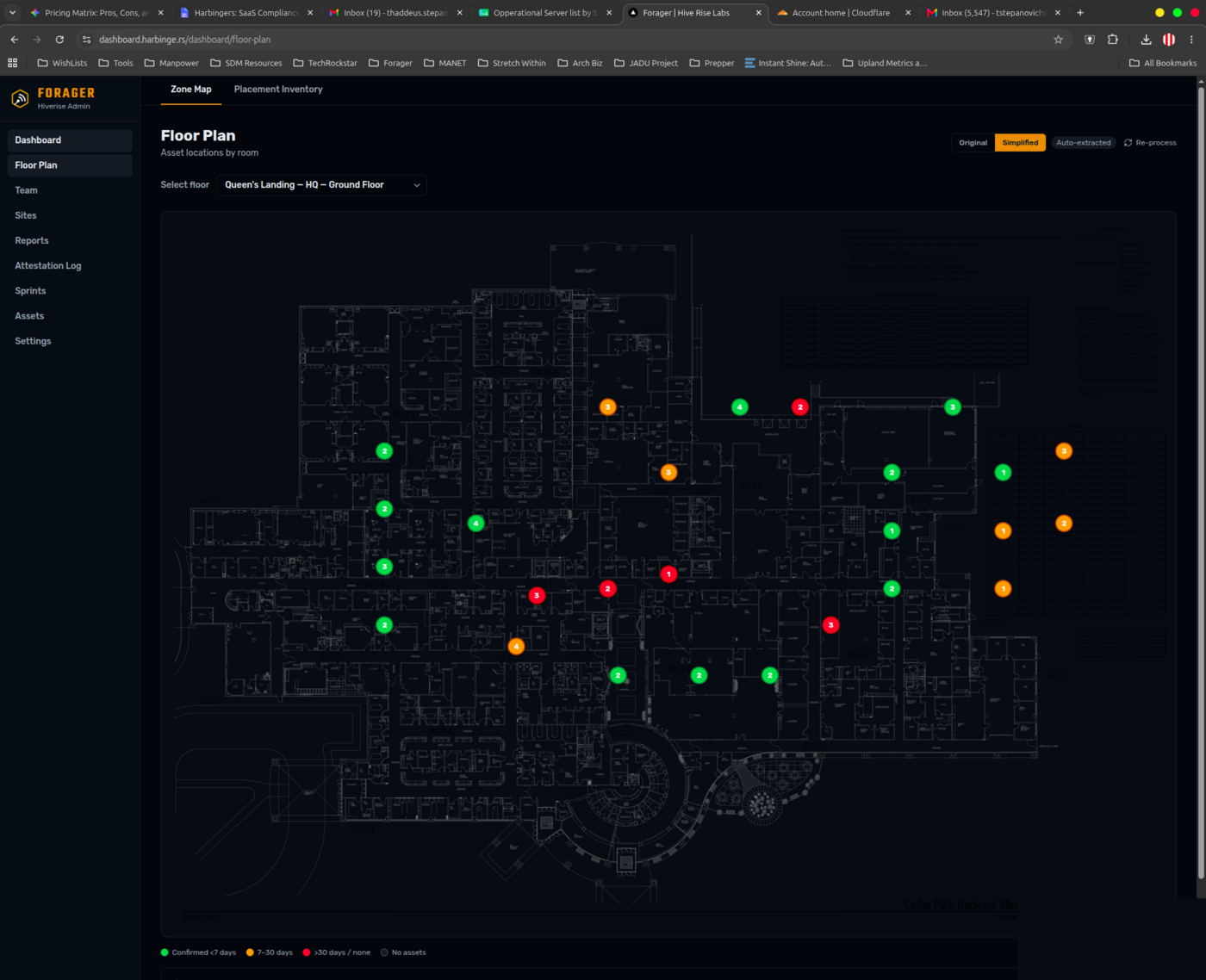
Open Forager. The floor plan shows every asset at its last confirmed location. Navigate to any asset directly from the map. Scan the barcode. One tap. The record updates instantly, timestamped and attributed to your user.
Upload your building's floor plans. Assets appear at their last confirmed location. Overdue assets are highlighted. Contractors who've never been in the building navigate directly to their assigned devices. No verbal briefing required.
Store PM schedules on asset records. The compliance dashboard shows every overdue and upcoming inspection sorted by urgency, automatically. Export a compliance-ready CSV for your auditor on demand. Joint Commission, DNV GL, and ISO 55000 evidence generated as a side effect of your field workflows.
When a bad firmware push takes down 40 carts, create a Remediation Sprint from the affected asset list. Assign devices by location to each tech. They open Forager, tap their next device, confirm, and mark resolved. You watch progress fill in on a live dashboard until every device is cleared.
Role-based access across your organization. Invite users, assign sites, control visibility. Manage multiple locations from one account; each site has its own floor plans, assets, and dashboards.
Web dashboard — Zone Map, Queen’s Landing · Ground Floor
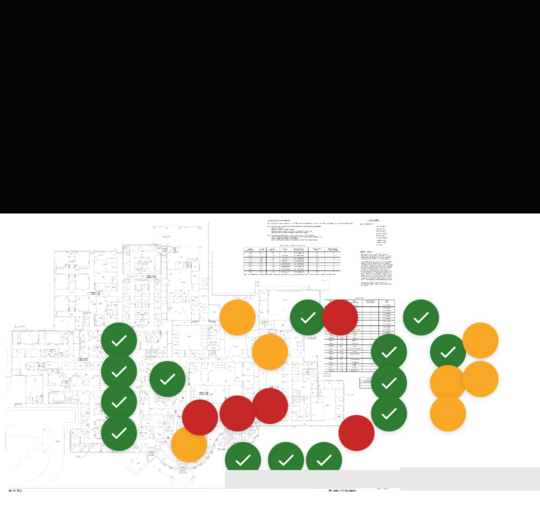
Android app — Zone Map, room attestation status

Walk each room once. Stand still for 30 seconds. Forager captures the RF fingerprint and pins it to your floor plan. Survey a 30-room floor in 2 to 3 hours.
See every room's survey quality at a glance: green (ready), yellow (weak signal), gray (not surveyed). Stale rooms flag automatically after 90 days.
The daily workflow. Open the app. Forager identifies the room from ambient RF. Scan barcodes. Each scan is a timestamped compliance record: asset, room, tech, time.
Full history of every confirmation: matches, mismatches, and new asset discoveries. Filter by type. Your IT director can pull an audit-ready export from the web dashboard.
Need to find a specific asset? Search by tag and see its last confirmed location, who confirmed it, and when. Narrow the search before you leave the desk.
All location features work without a CMDB connection. When connected, every confirmation POSTs to ServiceNow or any webhook-capable CMDB within seconds: no manual entry, no batch jobs.
Store inspection schedules on each asset record. The compliance dashboard surfaces overdue and upcoming devices automatically, sorted by urgency. Export audit-ready reports for Joint Commission, DNV GL, or ISO 55000 on demand.
When a mass incident affects a specific asset group, build a sprint from the affected list. Forager assigns devices by last-known location, navigates techs there via floor plan, and tracks resolution progress in real time.
Upload your floor plans. Assets appear at their last confirmed location. Overdue assets highlighted. Navigate directly from the map; contractors who've never been in the building find their assigned devices without a briefing.
Automatically captures a tight crop of the physical asset tag at scan time, with no extra step from the tech. The photo is linked to the attestation record. Proves physical presence, not just that a barcode was scanned.
Contractors place assets on a floor plan by scanning a barcode and tapping the map, before any zones are named or surveyed. Wall-to-wall inventory without waiting for RF setup.
Administrator, Team Lead, and Field Tech role tiers. Leads scoped to their assigned sites. Contractors get access to exactly what they need, nothing more.
Manage multiple locations from one account. Each site has its own floor plans, assets, dashboards, and inspection schedules. Full-fleet view across all properties.
Works with Zebra and Honeywell enterprise devices via DataWedge. Auto-detected on first launch. For camera-restricted environments and high-volume scanning workflows.
Select your target CMDB (Freshservice, Jira Assets, BMC Helix, Ivanti) and Forager reformats outbound webhook payloads to match that system's expected schema. No middleware required.
Enterprise customers who cannot use cloud infrastructure receive a custom APK built against their own Supabase instance. License expiry enforcement, MDM distribution support, Harbinge.rs-managed build pipeline.

Your IT director needs defensible location records for every regulated device on every floor. With Forager, every confirmation your techs made during normal ticket work is already logged: timestamped, attributed, exportable. The audit report takes minutes, not days.
Create a Remediation Sprint from the affected asset list. Forager assigns devices by last-known location to each tech, navigates them there via floor plan, and tracks progress in real time. You watch the dashboard fill in until every device is cleared.
It doesn't have to be a project. Every time a tech confirms a device during normal work, Forager pushes the updated location to ServiceNow (or any webhook-capable CMDB) within seconds. The database improves continuously without a cleanup effort.
They open Forager and see exactly where their assigned assets are pinned on the floor plan. No verbal briefing, no escort required. Every confirmation is attributed to them by name and timestamp: full accountability from the first scan.
Forager stores inspection schedules directly on each asset record. The compliance dashboard shows every overdue and upcoming device automatically, sorted by urgency. Export an audit-ready report for your surveyor in one click, with no spreadsheet reconciliation.
A barcode scan proves a tag was read. It doesn't prove someone was physically present with the device. Forager captures a photo of the physical asset tag at the moment of each scan, automatically and without any extra step. The image is linked to the inspection record and visible in the dashboard.
When a cart, panel, or piece of safety equipment moves between inspection cycles, Forager moves the record with it. Overdue items surface on the dashboard before the auditor surfaces them.
IT gear, biomedical equipment, and facilities assets all live in one platform, each with their own floor plans, dashboards, and inspection schedules. Shift-to-shift handoff without the guesswork.
A walked list is stale the moment an asset changes rooms. Temp staff and overtime cost real money for a one-time pass, and the record decays again before the next cycle. There's no timestamp, no attribution, and nothing to hand a surveyor who asks who verified what and when. Forager replaces the walk with the work your techs already do: every confirmation becomes a permanent, timestamped, attributed record, so the next PMI cycle starts from real data instead of zero.
The planned, long-term alternative once a facility has the budget and runway for infrastructure: $30 to $80 per device per year, plus $100,000+ before a single device is tracked. Forager is the option for right now: no readers, no AP survey, no beacon hardware, and a first floor producing records this week. See the full RTLS comparison.
Walk each room once. Forager maps it from ambient RF. A full floor takes 2 to 3 hours. Done once, refreshed as needed.
Techs scan barcodes during normal work. Forager identifies the room from ambient RF and updates each location record instantly. No extra step. No separate workflow.
Every scan is logged with asset, location, tech, and timestamp. Pull any compliance report on demand. Export for auditors with one click.
It runs over cellular or guest Wi-Fi on the phone already in your tech's pocket. No VPN. No MDM enrollment. No access points. No beacons. No network integration. There is nothing to install on your infrastructure, because Forager doesn't live there.
That changes what a review is about. There's no network architecture to assess, no endpoint agent to certify, no firewall exception to justify. What's left is a data question: what Forager collects, where it's stored, and who can see it. We've already answered it. Device identifiers are hashed before storage, asset tag photos are cropped on the handset before upload, Row-Level Security enforces tenant isolation, and a BAA is available.
A data review, not an infrastructure review. Most of what makes software implementations take six months isn't the review itself, it's the network changes, the endpoint certification, and the procurement cycle that comes with them. Forager has none of those to work through.
Rates are graduated, not flat. A 12,000-device fleet bills the first 9,999 at $15 and the remaining 2,001 at $12, for $173,997/yr total. You never pay more by growing, and the Enterprise rate applies automatically the moment you cross the line. No renegotiation, no plan change.
RTLS systems run $30 to $80 per device per year, plus $100,000+ in infrastructure before a single device is tracked. Forager is $15 per device. No infrastructure. No IT project. No six-month implementation.
Forager is self-deployed, so there's no mandatory engagement fee. If you'd rather have your floor plans prepped for you instead of doing it yourself, that's available as a flat, declinable line item: $500 for a single site, $1,500 for multi-site, any number of sites, one flat fee. Never a percentage of your license.
Annual subscriptions are billed in advance, in full, at signature. Multi-year prepay is available for buyers who want budget certainty: $13.50/device/yr on a 2-year term, $12.00/device/yr on a 3-year term.
Single site, up to 250 devices, $750 due at signature. That's a PO your director signs, not a capital request.
One agreement, signed once: your pilot opens a first-year license priced at the graduated rates above, invoiced at day 90 with your $750 pilot fee credited in full. Success criteria are agreed in writing at kickoff, so day 90 is a decision against a target you set, not a moving one. At day 90 you have a full exit right: walk away having paid only the pilot fee, nothing further owed.
Live in week one. Decide by day 90. See the day-by-day schedule or Start a Pilot →
Tell us about your facilities, your asset roster, and where the friction is today. We'll come back with a deployment scope and a specific number: no vague proposals, no extended sales cycle.